Get quick answers to the most common soundproofing questions, from product selection to installation tips, all in one convenient place.
Yes. As highlighted in this article, the recommendation would be to use acoustic mineral wool to insulate the cavity prior to soundproofing. If this isn’t done, the cavity can act as a sealed chamber with the sound amplifying and resonating inside.
All three stud wall soundproofing solutions have a 15mm acoustic grade plasterboard finish. This means they are decorated just as you would standard plasterboard. Usually a skim plaster on top of the plasterboard to cover any screw holes or joins. This then provides a flat even surface which can be painted, or wallpapered. For wallpaper, the recommendation would be to use a heavy-duty dry lining wallpaper first prior to the final wallpaper finish.
Soundproofing can be confusing, and it can be quite daunting wondering which system to choose. Choosing the right system can depend on:
It is always easier to treat the noise at the source. For example, if you can hear footsteps above, if possible, treat the floor. This helps to stop the impact vibration before it travels into the structure of the building. We realise this isn’t always feasible, in which case you would soundproof your ceiling.
Yes, absolutely. When the right system is used in the right situation, soundproofing can significantly reduce unwanted noise. With proper tried and tested soundproofing systems, such as the ReductoClip system for walls and SoundMat’s for floors, many homeowners experience a noticeable, life-changing difference in comfort and peace within their homes. See what our customers have to say: Customer Reviews
Decibels (dB) are a unit used to measure sound intensity. Decibels are measured logarithmically (not a percentage). This is a way of counting or measuring something that increases rapidly, or exponentially.
For example, if you were listening to your TV and the TV was set to volume 60, reducing 10dB of volume would be like turning the TV down from 60 to 30 (not 50 as people assume), so halving the volume. Reducing a further 10dB would turn the volume down from 30 to 15, a further 10dB reduction would turn the volume from 15 to 7.5 and so on halving every time. The size of the reduction gets smaller as the volume gets lower because the decibels at that lower volume are much smaller.
Learn more: Decibels explained
Airborne noise travels through the air (e.g. talking, music, TV).
Impact noise is a physical impact and structure-borne noise (e.g. footsteps, moving furniture, or dropped objects).
Each type requires a different soundproofing approach. Floors need impact isolation, while walls need mass and decoupling to block airborne noise.
There are times when the distinction between the two becomes more blurred, for example, an impact noise can also result in an airborne sound (think of clapping your hands). It might be that you need a higher performing system to reduce both types of noise.
Installation depends on the system and surface:
We provide full installation guides and videos and systems are designed for confident DIYers. Or you can hire a local tradesperson to do the installation for you.
Standard plasterboard adds a limited amount of mass to the wall, so doesn’t stop sound transfer effectively. Without decoupling, damping and adding high levels of mass, sound vibrations still pass through the wall. Proper soundproofing systems include:
Different types of mass also absorb different sound frequencies. Simply adding more of the same material won’t improve the sound blocking capabilities of the wall.
Acoustic wall panels, or timber slatted panels are used in sound absorption, not soundproofing. They reduce echo inside a room, but do not block sound from entering or leaving a room. SoundBoard 4 is a direct to wall soundproofing panel, especially effective on internal stud walls. ReductoClip Systems are more effective when soundproofing solid brick walls.
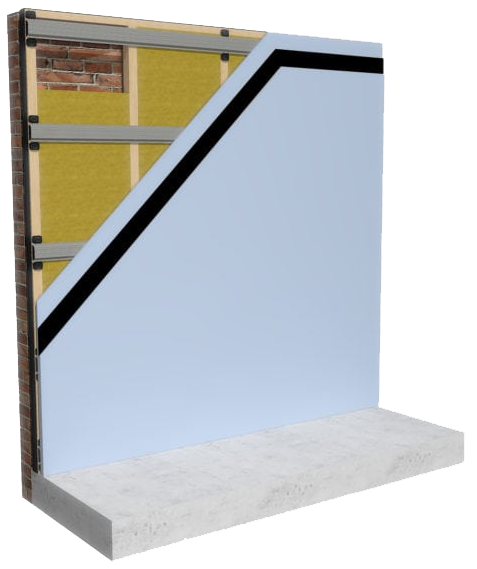
To soundproof a wall against noisy neighbours, you need to decouple it, add mass, and increase damping. Decoupling (e.g. building an independent wall with a gap) prevents vibrations from travelling through solid materials. Adding damping components like ReductoClips and FlexiSound helps absorb sound energy, while multiple layers of mass, such as Acoustic Plasterboard and FlexiSound block airborne noise across different frequencies.
The ReductoClip Independent Wall System combines all these elements, making it the most effective solution for blocking solid, brick party wall noise.
Although the terms are often used interchangeably, they describe slightly different things. Soundproofing refers to the overall process of blocking noise from transferring between rooms, for example, if you have a noisy neighbour and want to reduce the sound coming through the wall. Sound insulation refers to the specific materials used within a soundproofing system, such as acoustic mineral wool, which is fitted between wall, floor, or ceiling joists to reduce reverberation and prevent the “drum effect.” Sound insulation materials are part of an effective soundproofing solution, such as the ReductoClip System, but they do not provide soundproofing when used on their own.
The number of panels depends on the room size and shape. As a general guide, covering 20–30% of wall and/ or ceiling surfaces significantly improves sound clarity in most spaces. Fr accurate results, our expert team offers a free acoustic report showing the correct number of panels needed to achieve your desired echo reduction.